
There was more to him than he let on, asserts Aditi Phadnis.

The economic think-tank in its earlier projection had suggested that the Indian economy was likely to grow at 5.7 per cent in 2014-15.

The EAM when asked about his view of the world at present, said it would be "very grim forecast, for the next five years".
The downgraded World Bank forecast follows a similar move by the International Monetary Fund, which cut its growth forecasts two months ago

A top panel of economists on Monday slashed its forecast for US economic growth this year, saying the threat of war with Iraq was dampening consumer spending and business activity.

GST mop-up likely to fall in May, June after touching record levels in April and March.
The multilateral agency had earlier projected that the world economy would expand by 3.6 per cent this year.

Global head of equity strategy at Jefferies, Christopher Wood, has cut his exposure to Indian equities by one percentage point in the Asia-Pacific ex-Japan relative-return portfolio, and Australia and Malaysia by half a percentage point each in favour of China, which has seen a hike in exposure by two percentage points. The rally in China has been fast-forwarded by the approach of a seven-day holiday with the CSI 300 Index up 8.5 per cent on Monday, and 25.1 per cent in five trading days, he said.

'India's economy faces further downside risks from sluggish private investment and rural demand weakened by slow wage growth.'

There is a definite attempt to put the landslides on the backburner because news of them and climate change worry Wayanad's tourism and real estate businesses greatly. Whatever I experienced of Wayanad's 2024 by-elections; the July landslides were not a burning issue, observes Shyam G Menon.
'The central bank has highlighted that the slowdown in growth has been limited to a few sectors and overall growth is expected to pick up in the second half of the year.'

Multilateral lending agency Asian Development Bank said on Thursday it is likely to revise upwards by the September-end India's growth and inflation forecast, which is 8.2 per cent and 5 per cent respectively for the current fiscal.
The International Monetary Fund (IMF) has cut down its 2013 forecast for global economic growth to 3.9 per cent from the 4.1 per cent, trimming projections for most advanced and emerging economies.

"The stronger-than-expected start of the fiscal year has prompted . . . to revise India's annual growth forecast from 6.2 per cent to 6.4 per cent," Moody's economy.com, a research arm of Moody's, said in a release.

Central Statistics Office has come out with GVA to measure growth.

'We expect market consolidation and recommend buying during market dips.'
The December meeting of the Reserve Bank of India's (RBI's) six-member Monetary Policy Committee (MPC) will start on Wednesday even as there is no clarity on whether Governor Shaktikanta Das, the chair of the panel, will continue in office after his term ends next week. The outcome of the meeting will be announced on Friday by Das at 10 in the morning.

The Indian economy is reviving, helped by positive policy actions.

CRISIL also expects the average Wholesale Price Index inflation to be higher at around 8 per cent as against of 7 per cent estimated earlier.
The National Council of Applied Economic Research has revised its forecast for the country's gross domestic product growth for 2006-07 to 8.44 per cent
While the latest consensus still suggests growth will beat the rate of less than 5 per cent seen in the past two years, it does not reflect the stock market euphoria since Prime Minister Narendra Modi's historic election win two months ago.

Global rating agency Fitch on Thursday affirmed India's 'BBB-' rating with a stable outlook on strong growth outlook and fiscal credibility. Fitch said India is set to remain among the fastest-growing sovereigns globally with GDP growth of 7.2 per cent in the current fiscal year and 6.5 per cent in FY26, down from 8.2 per cent in FY24. "Fitch Ratings has affirmed India's Long-Term Foreign-Currency Issuer Default Rating (IDR) at 'BBB-' with a Stable Outlook," the global rating agency said in a statement.

Describing the "lower agriculture output" as the "immediate challenge", Nomura said it could be a drag on GDP in the next quarter and on rural consumption. "But we expect urban consumption to rebound due to better job prospects," it said.
NCAER has pegged the growth rate between 4.9 and 5.2 per cent, led by healthy projections in the industrial output and services sector.
S&P Global Ratings on Wednesday said the second wave of COVID infections poses downside risks to India's GDP and heightens the possibility of business disruptions. The second wave brings in uncertainty and a drawn-out COVID outbreak will impede India's recovery, it said.
The Prime Minister's Economic Advisory Council has projected India's GDP growth at 5.3 per cent in 2013-14.
Fiscal correction is needed even after the changes that have been made now, otherwise the fiscal deficit would tend to be high.
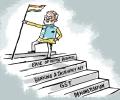
Three-quarters into the 10 years that Mr Modi had sought for transforming India, the 'output' numbers look impressive, but the key 'outcome' numbers don't show up much, if at all, observes T N Ninan.

Finance Minister Nirmala Sitharaman is likely to strike a fine balance between being fiscally prudent and growth supportive when she presents her fourth straight budget on Tuesday, which is expected to have plans to boost spending to revive investment and create jobs. The Budget for the fiscal year starting April 1, 2022 is likely to raise spending on infrastructure to set the economy on a firmer footing. The stage for the Budget presentation was set by the Economic Survey stating that the government has the fiscal space to do more to support the economy that is forecast to grow at a healthy 8-8.5 per cent growth in the 2022-23 fiscal.
The Nifty ended at 4,867, down 77 points.

India's economy is forecast to grow at 4.8 per cent in 2013, down 1.3 per cent from its earlier projection, the UN's World Economic Situation and Prospects 2014 report said.

Wall Street brokerage Goldman Sachs has lowered its estimate for India's economic growth to 11.1 per cent in fiscal year to March 31, 2022, as a number of cities and states announced lockdowns of varying intensities to check spread of coronavirus infections. India is suffering the world's worst outbreak of COVID-19 cases, with deaths crossing 2.22 lakh and new cases above 3.5 lakh daily. This has led to demand for imposition of nationwide strict lockdowns to stem the spread of the virus - a move that the Modi government has so far avoided after the economic devastation last year from a similar strategy.

India's services sector growth recorded another month of robust expansion in July, albeit at a slightly slower pace than in June, largely supported by robust demand conditions and investment in technology, a monthly survey said on Monday. The seasonally adjusted HSBC India Services Business Activity Index was at 60.3 in July, down only fractionally from 60.5 in June. In the Purchasing Managers' Index (PMI) parlance, a print above 50 means expansion, while a score below 50 denotes contraction.

Stressing that economic growth will only move upwards, the Reserve Bank of India Governor Shaktikanta Das on Friday pegged the GDP growth rate for the next financial year at 10.5 per cent, though a tad lower than the government's projection of 11 per cent. The projection is in line with the estimates in the Union Budget 2021-22 presented in Parliament earlier this week. The Economic Survey, tabled by the government in Parliament recently, has projected that the economy will grow at 11 per cent, up from an estimated historic decline of 7.7 per cent in 2020-21, on account of the COVID-19 pandemic.
Professional forecasters have added to Reserve Bank of India Governor Duvvurri Subbarao's dilemma on timing the exit from an accommodative monetary policy stance.
The NSE Nifty, after shuttling between 10,331.80 and 10,227.45, finally settled 196.75 points, or 1.94 points higher at 10,325.15.
HSBC on Monday lowered India's GDP forecast for the current financial year to 4 per cent from 5.5 per cent earlier saying economic uncertainty is likely to weigh on the growth forecast in the coming months.
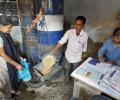
There are reports that the government will soon cut income taxes by about Rs 50,000 crore to boost consumption.
Prime Minister Modi, I suggest that, instead, you distribute about one lakh crore rupees per year to the 80 crore poor, which will boost both consumption and economic growth, suggests Kalyan Singhal, McCurdy Professor of Business at the University of Baltimore.

In the first quarter of FY14, real GDP growth estimated by the Central Statistics Office stood at 4.4 per cent on a factor cost basis, and at 2.4 per cent on a market price basis, the IMF said.
